The 5 Ws
Checks whether the narrative establishes who, what, when, where, and why—with enough clarity to act on.
Coverage
SAR Chasm reviews draft SAR narratives for the gaps that survive a checklist—because “the activity was suspicious” is not an explanation.
Built for people who write, review, and rely on SAR narratives.
The narrative identifies the activity, but the basis for suspicion is not fully supported.
Illustrative output · not an actual case
No decorative dashboard. The interface keeps the draft, safety boundary, and scorecard in the same line of sight.
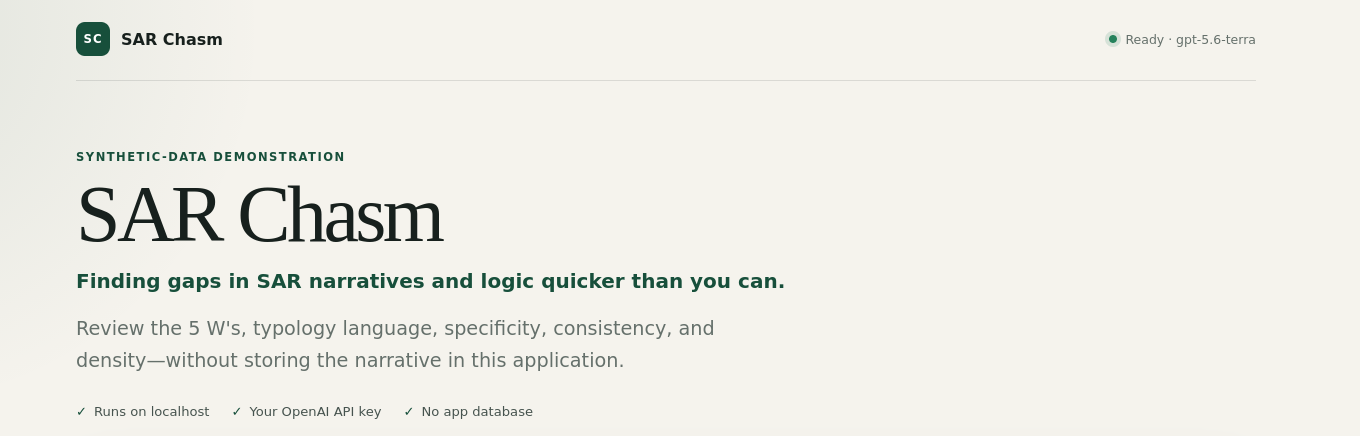
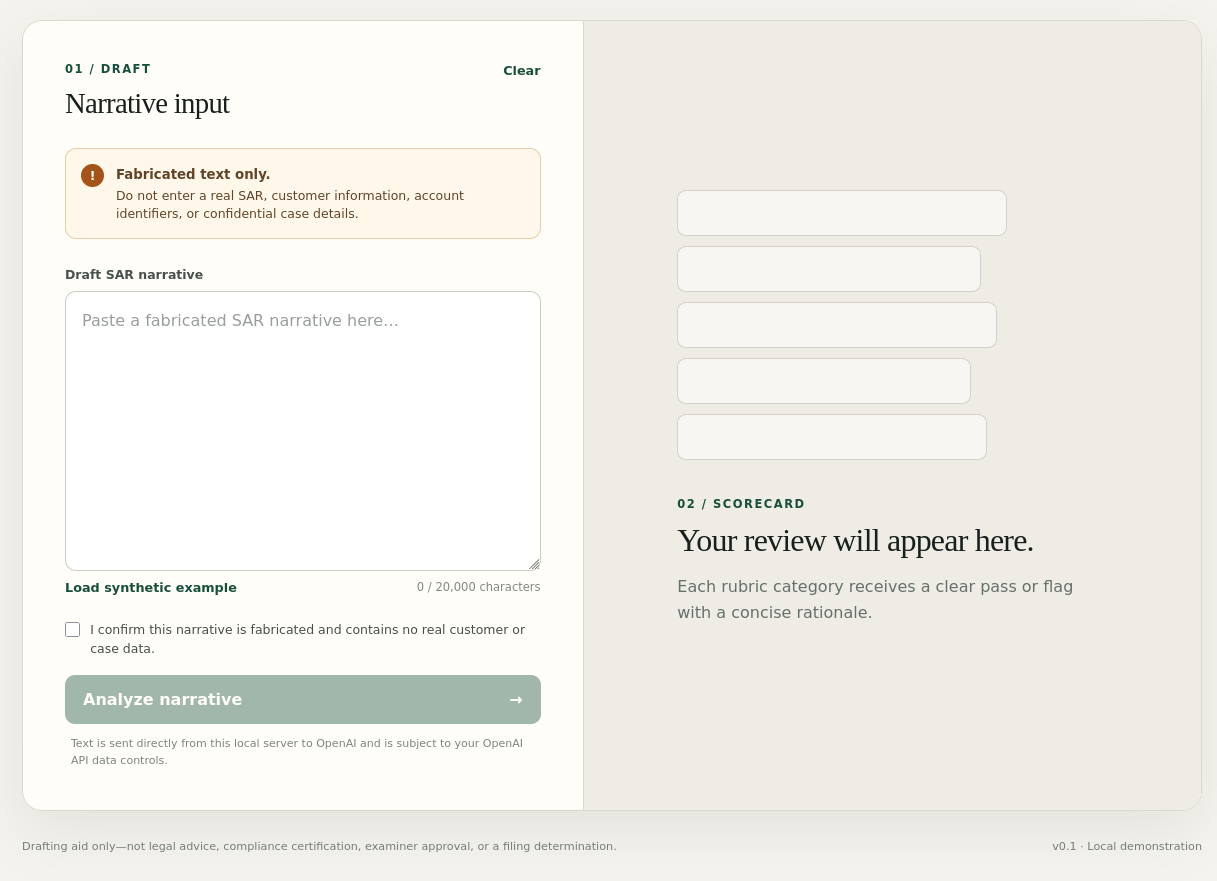
The application runs locally with fabricated narratives only. v0.2 adds dark mode, pass/flag totals, copyable reviews, clearer input guidance, a keyboard shortcut, and an explicit 20,000-character boundary.
Not proofreading. Not a filing decision. A repeatable rubric for the distinctions an experienced reviewer already makes.
Checks whether the narrative establishes who, what, when, where, and why—with enough clarity to act on.
Tests whether labels such as structuring, funnel activity, or money laundering are used accurately and supported by the facts.
Finds vague claims, missing amounts, weak behavioral detail, and profile comparisons that never establish the customer’s baseline.
Cross-checks chronology, arithmetic, parties, transaction totals, and statements that conflict elsewhere in the narrative.
Flags bloated passages and repetition without treating brevity as the goal. The aim is a narrative that is efficient, complete, and usable.
Useful QA separates a material weakness from everything the narrative already does well.
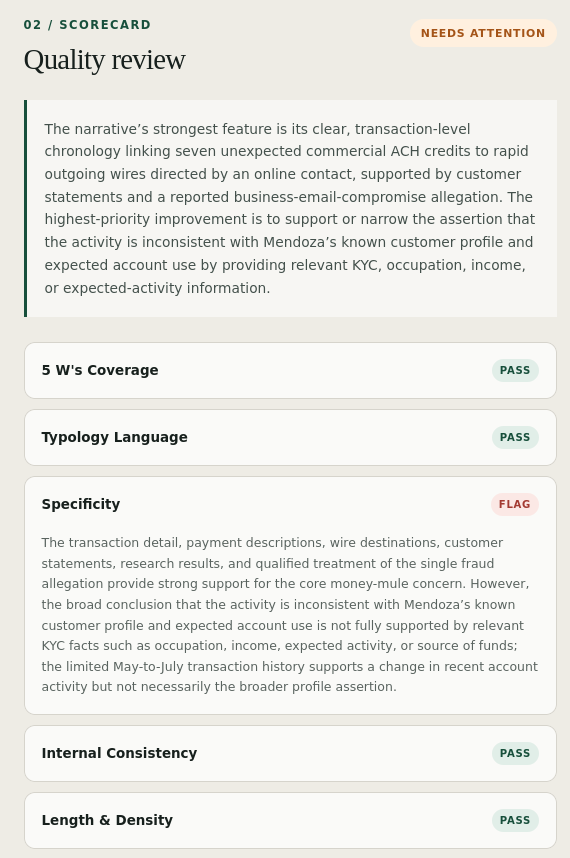
The transaction evidence is strong. The broader customer-profile conclusion is not. SAR Chasm flags the unsupported leap without manufacturing problems elsewhere.
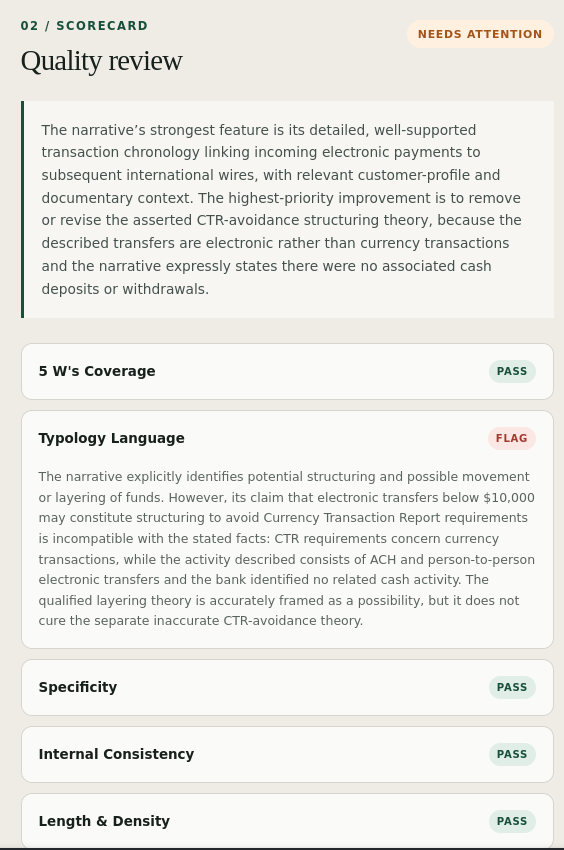
The narrative is detailed and internally consistent. Its CTR-avoidance theory is still wrong for the electronic activity described, so the typology language gets the flag.
Fabricated demonstration narratives only. No real customer, account, investigation, or SAR information.
The final v0.2 regression round passed every scenario, including crypto flows, unsupported attribution, arithmetic mismatches, clean controls, and adversarial text embedded inside customer-provided material.
Start with the narrative as written. No case-system integration required for the prototype.
SAR Chasm evaluates the text across the five QA categories and tests factual relationships within it.
See passes, items needing attention, and specific flags—with a reason attached to each one.
See what rule fired, disagree with it when warranted, and change the draft—or leave well enough alone.
A narrative can contain every required element and still leave the next person doing unnecessary reconstruction. The dates may be there but hard to follow. A typology may be named but not demonstrated. The total may be stated but not reconcile.
SAR Chasm is being built to find that gap while there is still time to close it—and to recognize when the narrative is fine as written.
Today, SAR Chasm is deliberately limited to fabricated narratives on localhost. That proves the review method without pretending the hard deployment questions have already been solved.
The practical destination is different: a quality-review capability deployed inside a financial institution’s approved environment, working with its own EDP, access controls, retention rules, and model-governance decisions. Not a public website where investigators paste confidential casework.
It is making experienced QA judgment more consistent, explainable, and difficult to skip—without moving the filing decision away from the people accountable for it.
A structured QA pass for draft narratives, designed to make omissions and inconsistencies easier to see.
A filing decision, legal conclusion, compliance certification, or an excuse to upload confidential SAR data because the interface looks nice.
A localhost-only demonstration for fabricated narratives. No accounts, uploads, saved history, filing integration, or production support.
SAR Chasm is being tested against fabricated narratives—some obvious, some subtle, and some clean enough to test whether it can leave well enough alone. Practitioner beta access will open in a limited group.